
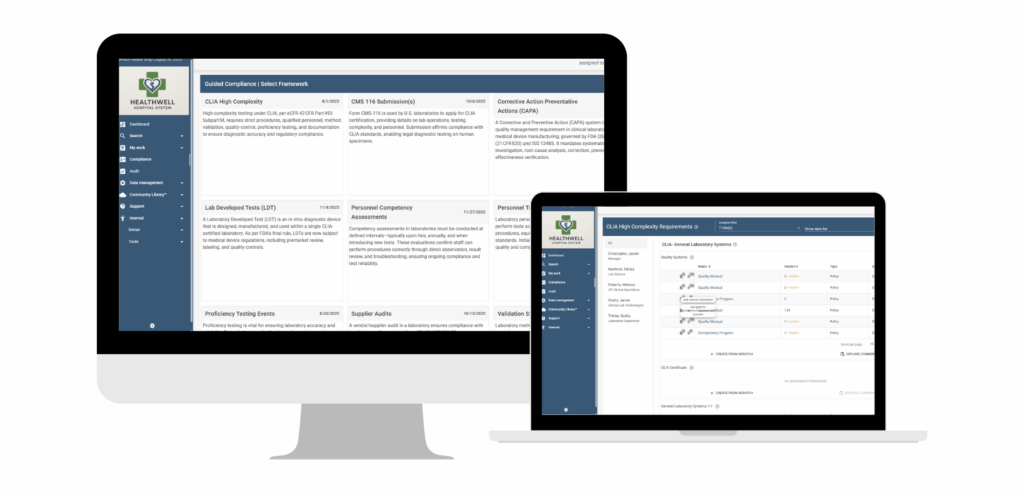




TPL Quality Activities transform traditionally static quality records into structured, interactive data assets that drive consistency, traceability, and continuous compliance. Instead of managing disconnected files or spreadsheets, organizations use customizable digital templates purpose‑built for training, competency assessments, CAPAs, and other quality activities at the point of work.
Templates in TPL are interactive, guiding users through required fields, logic, and assignments in real time. This ensures data is complete, actionable, and directly tied to employees, sites, products, and regulatory requirements, eliminating gaps caused by manual or post‑hoc tracking.
Designed for scale, TPL enables multi‑employee and multi‑site template assignment from a single source of truth. A validated training, competency, or quality template can be deployed across techs, sponsors, laboratories or organizations (tech transfer) while preserving local execution, accountability, and full audit trails at every site, test system, and product.
TPL Policy Control replaces fragmented document management with a single authoritative policy ecosystem built for regulated laboratories and multi‑site organizations. Policies live in one secure, collaborative, cloud‑based environment, eliminating downloads, uploads, email attachments, and version confusion.
With real‑time collaboration, teams across departments and locations work directly within the same policy, ensuring updates, reviews, and approvals happen instantly and transparently. Every policy maintains one controlled copy, with full traceability, audit history, and role‑based access preserved automatically.
TPL’s AI‑generated and AI‑assisted policy creation accelerates documentation while aligning content to applicable regulatory frameworks from the start. Policies are continuously mapped to regulations, reducing manual interpretation, minimizing gaps, and supporting audit readiness without added workload.
Designed for distributed organizations, Policy Control enables multi‑site data distribution from a single source of truth. One policy can be deployed across multiple laboratories, locations, or partner organizations, ensuring consistency while preserving local accountability and complete audit trails at every site.
TPL embeds regulatory requirements directly into the platform, eliminating the need to search across binders, spreadsheets, or external references. Regulatory frameworks are available in‑system, providing clear visibility into what is required and how each requirement is met across policies, procedures, training, competencies, and CAPAs.
Regulations in TPL are aligned with industry best practices, ensuring compliance is not treated as a static checklist, but as a living system integrated into daily operations. In‑system regulatory guidance and examples help teams understand expectations, reduce interpretation errors, and apply consistent standards across sites and teams.
Unlike traditional systems where regulations and documentation live separately, TPL uses AI to align a single set of quality data and evidence across multiple regulatory bodies at the same time. Regulatory requirements are mapped directly to policy and process evidence, including structured documents, workflows, forms, and employee activities. This creates a clear, traceable connection between each requirement and the evidence that supports it.
By building compliance from the regulatory foundation, TPL enables organizations to create policies and processes that are inherently compliant, auditable, and scalable, across departments, laboratories, and regulatory bodies, while maintaining continuous readiness without last‑minute evidence gathering.
TPL Best Practices embed proven, industry‑aligned guidance directly into the platform, serving as the practical bridge between Regulations and Quality Data. Rather than treating best practices as informal guidance or external references, TPL makes them built in, actionable, and system‑enforced from day one.
Best practices in TPL are directly aligned with Regulations, translating regulatory requirements into clear, defensible ways of working. This ensures teams don’t just know what is required, they understand how to meet expectations through standardized, audit‑ready policies, processes, and workflows. As regulations evolve, best practices remain anchored to those requirements, maintaining continuous alignment across the organization.
By embedding best practices into everyday workflows, TPL fills critical knowledge gaps across roles, experience levels, and sites. New staff, expanding teams, and multi‑site organizations benefit from system‑guided execution that reinforces consistency, reduces variability, and ensures that best practices are applied uniformly, without relying on tribal knowledge or constant oversight.
Together, Regulations define the requirements, Best Practices define how to meet them, and Quality Data captures the evidence, creating a closed‑loop compliance system that is scalable, auditable, and resilient.
TPL Audits are designed to be real‑time and low‑effort, eliminating the traditional rush to prepare for inspections. Instead of treating audits as episodic events, TPL embeds audit readiness directly into daily operations, so compliance is continuously maintained and auditable at any moment.
Because policies, quality data, training, competencies, CAPAs, and regulatory requirements all live in a unified system, audit evidence is created automatically as work is performed. Documents, versions, approvals, assignments, and completions are already linked and traceable, removing the need for manual evidence collection, document hunting, or last‑minute reconciliation.
TPL dramatically reduces audit effort by aligning audits to existing data rather than requiring separate audit workflows. Approved policies, completed processes, and structured quality data feed directly into audit views, allowing teams to demonstrate compliance with minimal disruption to operations. This low‑effort model reduces staff burden, minimizes error, and shortens audit preparation time.
By making audits a natural outcome of real‑time work, not a separate project; TPL enables organizations to stay inspection‑ready, confident, and in control across sites and regulatory bodies.
TPL connects laboratory systems and quality data to provide a single, inspection‑ready view of laboratory activity, without replacing existing systems.
TPL integrates via API with LIMS, monitoring systems, and EHRs, abstracting and aggregating data into a unified, traceable framework. Operational events, quality evidence, and contextual data are linked together so teams can understand what happened, when, by whom, and under what controls.
Instead of searching across disconnected platforms, TPL Tracing presents all activity associated with a patient, specimen, test, or process in one structured, auditable view. LIMS execution data, EHR context, and TPL quality records remain sourced from their systems of record while being traceably aligned in TPL.
TPL provides customizable trace reports, allowing organizations to generate outputs tailored to audits, investigations, quality reviews, billing validation, and regulatory requests. Traces can be viewed in structured formats that surface key events, handoffs, and decision points across the testing lifecycle, making gaps, errors, or inefficiencies easier to identify and address.
By unifying operational data, quality evidence, and clinical context into a single trace, TPL enables faster, more confident responses to audits, adverse events, and performance questions, without reconstructing timelines or pulling data manually from multiple systems.
TPL Tech Transfer enables CROs, CDMOs, and laboratory networks to securely exchange protocol, operational, quality, and study data while preserving structure, context, and auditability across organizational boundaries. Built on TPL’s interoperability layer, Transfer eliminates risks introduced by manual handoffs, fragmented file sharing, and disconnected systems during tech transfer and study transitions.
TPL supports the controlled movement of training procedures, protocols, methods, quality templates, and quality documentation across sponsors and organizations. This ensures continuity of oversight, submission‑ready records, and a defensible audit trail as programs scale, change manufacturing or testing partners, or move between development phases, without recreating documentation or losing institutional knowledge.
Sponsor‑ and study‑specific requirements remain intact, preserving data integrity and regulatory alignment as studies expand, replicate, or transition across organizations.
By centralizing and governing cross‑organization data movement, TPL Tech Transfer enables confident collaboration across CROs, CDMOs, sponsors, and systems, reducing transfer friction, protecting data integrity, and ensuring transferred data remains complete, and inspection‑ready at every stage of the lifecycle.
TPL Analytics provide bespoke, risk‑assessment–driven insights built directly on top of your policies, quality data, training, competencies, and regulatory requirements. Rather than offering generic dashboards, TPL analytics are configurable to reflect each organization’s structure, roles, sites, and risk priorities, ensuring leaders see what is most relevant to their operations.
Analytics in TPL are risk‑focused by design, continuously evaluating signals such as overdue training, incomplete competencies, inactive policies, unmet regulatory requirements, and unresolved quality events.
Because TPL analytics are built on structured, real‑time data, users can drill down from high‑level risk indicators into specific documents, assignments, or workflows. This enables faster root‑cause identification, targeted intervention, and informed decision‑making, without manual data aggregation or spreadsheet analysis.
By delivering tailored, risk‑based visibility, TPL Analytics shift organizations from reactive reporting to proactive oversight, helping leaders prioritize action, reduce exposure, and maintain continuous readiness across complex, multi‑site environments.


AI Content Creator
Unparalleled multi-media detail
Easy navigation
Interactive communication
Notifications and reminders
Digital end-to-end execution
Share best practices and learn from others
One-on-one TPL support

© 2025 The Proficient Lab, all rights reserved